Conductive Bakelite (cylindrical section)
Material ID: 120

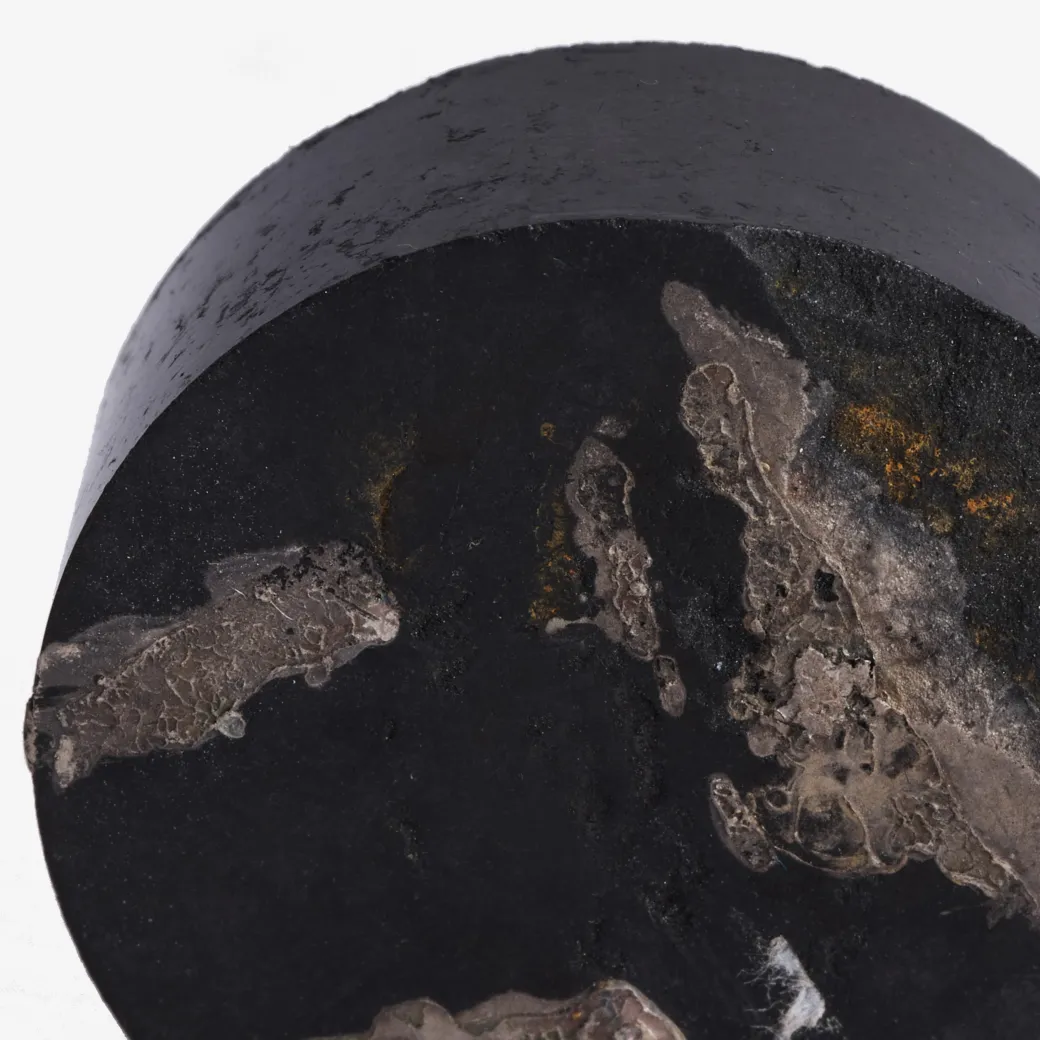


Description
Bakelite, invented by Leo Baekeland in 1907, was the first plastic made from synthetic components. He was attempting to develop a material which would be an economical and synthetic alternative to shellac, a natural polymer which was beginning to see use in the growing electronics industry but was expensive and tended to degrade over time. Bakelite is a thermosetting phenol formaldehyde resin, formed by reacting phenol and formaldehyde.
When it was first invented, it was revolutionary as an easy to mould, heat- and chemically resistant, electrically insulating material, which could take different dyes and patterned finishes. This saw it quickly adopted for use in the casing of radios and telephones, as well as in kitchenware, jewellery, toys and automobiles.
To lend the material extra strength, Baekeland added filling materials to the resin, such as cotton, wood dust and asbestos fibres. This sample contains carbon black filler, making it electrically conductive. Cylindrical sections like this are used to encapsulate scientific and medical samples for imaging under scanning electron microscopes (SEM), instruments which can magnify to more than 500,000 times. These microscopes work by scanning samples with a focused beam of electrons. However, because electrons carry an electric charge, samples which aren’t electrically conductive become charged with static – like when you rub a balloon on your jumper – and this static ruins the microscope image. Mounting samples in conductive Bakelite (and coating them in a very thin layer of gold) allows electrons to flow around the sample, to create the best image.
Bakelite paved the way for plastics to revolutionise the material world. In fact, so many new plastics were developed in the decades following Bakelite’s invention, that it became difficult to tell them apart, and Bakelite became the generic name for this group of new materials. The unmistakeable way to tell if an object is made from real Bakelite is to rub it. When warmed by friction, Bakelite gives off a tell-tale pong of formaldehyde.
Particularities
State
Categories
Chemical Symbol
Donated by
Val Randle, Swansea University
Library Details
Site
Bloomsbury
Status
In Library
Location
Wooden Shelves
Form
Disc
Handling guidance
Wash hands after handling.
Date entered collection
Sunday 30th March, 2008


